
Santé droits sexuels et reproductifs au Burundi : survivre au gel des aides, un défi pour les OSCs.

Au Burundi, la santé sexuelle et reproductive (SSR) reste un sujet à la fois central et inconfortable. Central, parce qu’il touche à la vie, à la dignité et à l’avenir des jeunes et des femmes. Inconfortable, parce qu’il demeure entouré de tabous, et de perceptions parfois éloignées des réalités vécues.

À cette complexité s’ajoute aujourd’hui un nouveau facteur de fragilisation : le retrait progressif de certains bailleurs internationaux et les restrictions budgétaires qui en découlent. Parmi les cas concrets observés récemment figurent notamment la fermeture prochaine de l’ambassade du Royaume des Pays-Bas au Burundi, ainsi que les restrictions, voire le gel, de l’aide américaine.

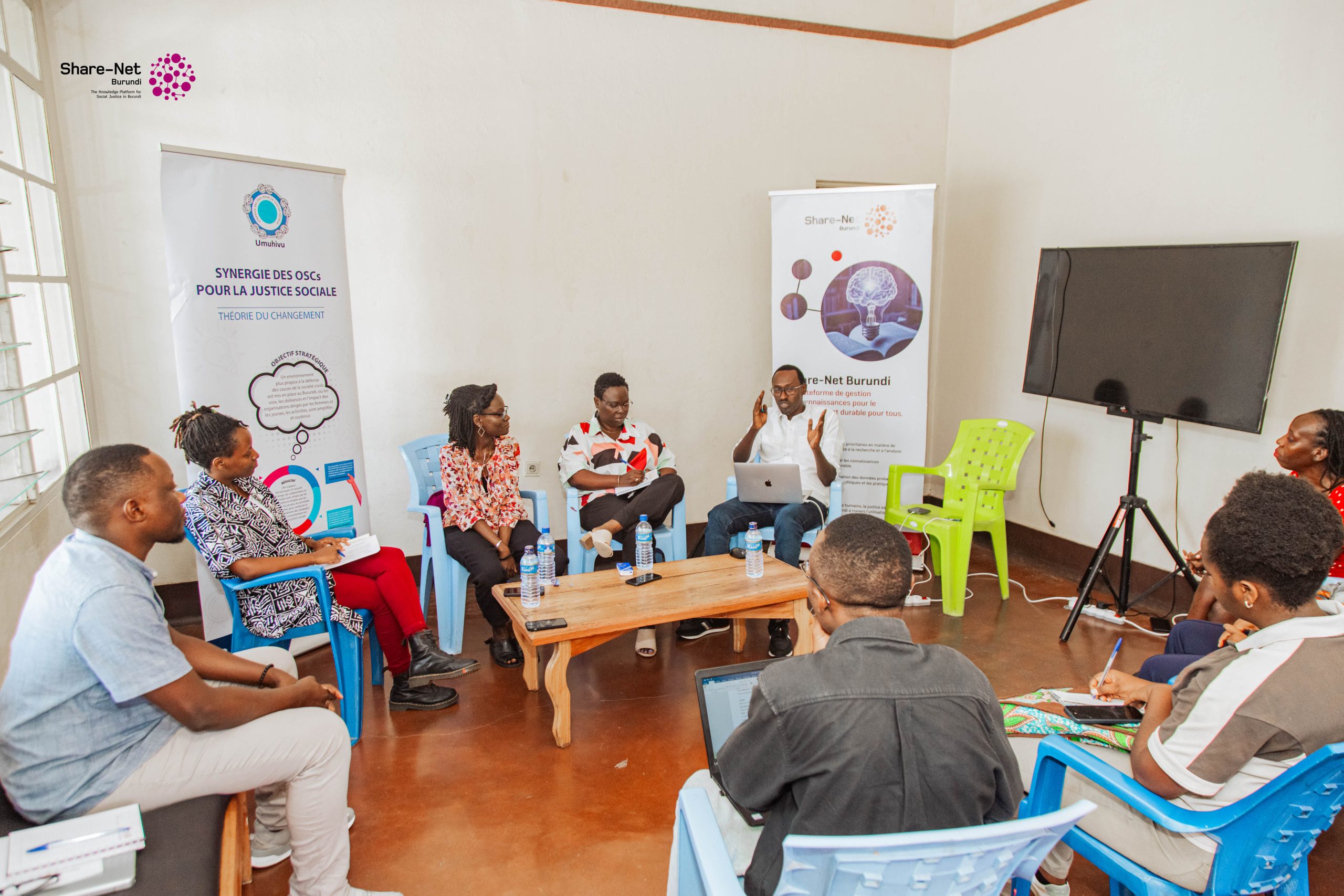
C’est autour de cette problématique que s’est tenue, le 24 décembre 2025 au siège de ShareNet Burundi, une table ronde consacrée au rôle des organisations de la société civile (OSC) dans la pérennisation des acquis en SSR, dans un contexte financier de plus en plus contraint.

La SSR, une thématique encore mal assumée

Pour ouvrir les échanges, les participants à la table ronde ont mis en lumière un constat largement partagé : au Burundi, la sexualité reste un sujet peu discuté socialement et rarement assumé politiquement.« La sexualité, on la pratique, mais on en parle peu. On s’en remet souvent à l’école ou aux structures de santé, mais le dialogue au sein des familles ou des communautés reste quasi inexistant », a souligné Fidélité Ishatse, journaliste engagée dans la promotion de l’égalité des genres, invitée à cette rencontre.

Au-delà de la thématique elle-même, la question des programmes en matière de SSR a également été soulevée. Pour Hugues Nkengurutse, titulaire de formations académiques en management des médias, en sciences de la gouvernance, ainsi qu’en sciences politiques et relations internationales. Ces programmes sont façonnés par un jeu complexe de perceptions : celles des bailleurs, celles des organisations de mise en œuvre et celles des communautés bénéficiaires.

Comme l’explique-t- il, les bailleurs arrivent avec des objectifs et des indicateurs qu’ils mettent en avant pour mobiliser des fonds auprès des donateurs initiaux. Les OSC, à leur tour, ont des besoins financiers à satisfaire et doivent, à un moment donné, s’adapter pour survivre et continuer à exister.

Par ailleurs, les bénéficiaires peuvent eux aussi, volontairement ou non, constituer un frein, lorsqu’ils ne perçoivent pas clairement les problèmes auxquels ils sont confrontés ou lorsqu’ils restent à l’écart des processus de décision. Une question devient alors incontournable, poursuit Hugues Nkengurutse : « Comment pérenniser les acquis en matière de SSR au regard de tous ces facteurs ? »

Le départ des bailleurs : choc ou opportunité ?

Le retrait ou la réorientation de certains bailleurs – notamment vers des collaborations directes avec l’État – constitue un choc pour de nombreuses OSC. Leur affaiblissement à court terme semble inévitable, malgré la contribution qu’elles ont apportée jusque là. Ce contexte agit cependant comme une épreuve de vérité, révélant les fragilités structurelles du système et obligeant toutes les parties prenantes, le gouvernement, les OSC et les bénéficiaires, à se remettre en question, selon Hugues Nkengurutse.

Il s’interroge notamment sur la capacité de l’État à prendre le relais. Le budget national ne comporte pas toujours de lignes clairement dédiées à la SSR, malgré le caractère vital de ce domaine. Le gouvernement pourra-t-il combler le déficit occasionné par le retrait des bailleurs ?

Du côté des OSC, Fidélité Ishatse appelle à une introspection profonde. Elle invite les organisations à s’interroger sur leurs pratiques, notamment leur degré d’appropriation des projets, leur dépendance aux gains pécuniaires, la concurrence parfois exacerbée entre organisations œuvrant pour les mêmes causes, ou encore la place réelle de l’engagement citoyen dans leurs initiatives.

Vers des solutions “home made” ?

Face à ce nouveau contexte, une idée s’impose progressivement : le départ des bailleurs peut aussi constituer une fenêtre d’opportunité pour repenser les interventions en SSR de manière plus endogène. C’est la réflexion portée par Dr Christella Kwizera, sociologue et enseignante à l’Université du Burundi. Selon elle, cela impliquerait notamment de redocumenter les pratiques positives qui existaient avant l’ère des projets fortement financés et de valoriser les savoirs traditionnels.

Pour appuyer son propos, l’universitaire évoque des exemples issus de la société burundaise d’autrefois : « Il existait des moyens ou des pratiques traditionnelles par lesquels les couples pouvaient espacer les naissances. Un homme pouvait, par exemple, quitter volontairement le foyer pour une certaine période. Certains tradi-praticiens revendiquent également des solutions adaptées. Mais ces pratiques ont perdu leur place face à une modernité qui impose des solutions importées de l’extérieur. »

Dans cette logique, une meilleure gestion du départ des bailleurs passerait aussi par l’inclusion, au sein des OSC, d’acteurs souvent peu impliqués dans les programmes de SSR. Dr Kwizera cite notamment les hommes, appelés à soutenir leurs épouses, ainsi que certains membres des communautés concernées, généralement désignés comme bénéficiaires.

La pérennisation des acquis, une affaire de remise en question

Pour Hugues Nkengurutse, la pérennisation des acquis passe avant tout par une meilleure appropriation : « D’abord par l’État, en réorientant ses priorités. Ensuite par les bénéficiaires, en devenant acteurs et non simples récepteurs. Enfin par les OSC elles-mêmes, en anticipant les chocs. »

Selon lui, la pérennisation des acquis en santé sexuelle et reproductive ne dépend pas uniquement de la disponibilité des financements : « Elle repose surtout sur la capacité collective à se remettre en question, à aligner les projets sur les réalités vécues et à redonner du sens à l’engagement social. Le contexte actuel, aussi difficile soit-il, invite à cette lucidité. »

De son côté, Dr Christella Kwizera estime qu’il est également nécessaire de renforcer l’implication des femmes, qui comprennent souvent mieux que d’autres les causes pour lesquelles les OSC militent. « Les luttes deviennent plus engageantes lorsqu’elles sont portées par celles et ceux qui subissent les problèmes, plutôt que par ceux qui les abordent comme un simple travail », conclut-elle.

Let’s talk abortion: Break the stigma

Meena, 17 year old went to traditional birth attendant to abort her pregnancy. As a treatment, the attendant inserted an herbal tree branch into her uterus which caused severe pain and heavy bleeding. Later, she came to know that she can never become a mother.

Like her, every year, around 572,000 women suffer from unsafe abortion in Bangladesh, showed in the research done by Guttmacher.

Bangladesh is dealing with the topic of abortion in different ways. In the history of Bangladesh, abortion was legal after liberation war for those women who had been raped during the war. Later in 1976, Bangladesh National Population Policy tried to legalize abortion for first trimester; however it did not work out, it was only legal when a woman’s life was in danger. Menstrual Regulation (MR) was introduced to the people of the Bangladesh in 1979. It has been practiced since then and Bangladesh government allows it over abortion. Still the country is under the penal code from 1860, which means induced abortion which is procedure to end pregnancy is illegal unless if the woman’s life is at risk.

https://www.guttmacher.org/about/journals/ipsrh/2013/07/acceptability-and-feasibility-mifepristone-misoprostol-menstrual

Research paper on Abortion


le projet Agateka de SaCoDé a récemment gagné le prix Jonhson&Johnson des projets innovants

Johnson & Johnson Names Winners of First Africa Innovation Challenge
Competition Part of Company’s Eighty-Five Year Commitment to Supporting Entrepreneurs, Science Education Opportunities, and Health Systems Across the Continent

CAPE TOWN, SOUTH AFRICA, March 14, 2017 – Johnson & Johnson today named the winners of the first Africa Innovation Challenge at the Global Entrepreneurship Congress. The initiative, which received nearly 500 submissions from innovators and entrepreneurs across the continent, sought the best ideas for new, sustainable health solutions that will benefit African communities. The Johnson & Johnson Family of Companies comprises the world’s largest healthcare business and its presence in Africa dates back to 1930, including business operations, public health programs and corporate citizenship. The Africa Innovation Challenge is part of the company’s comprehensive approach to collaborate with and support Africa’s vibrant innovation, education and health systems institutions.

Johnson & Johnson Launches an Africa Innovation Challenge for Budding Healthcare Entrepreneurs

In addition to the Africa Innovation Challenge winners, the company also announced today that it is a major partner of Women in Innovation and the Alliance for Accelerating Excellence in Science in Africa, programs that seek to substantially increase the number of women on the continent working in the sciences. These announcements follow the prior week’s opening of two new Johnson & Johnson regional officesin Ghana and Kenya, which along with our South Africa-based global public health headquarters, will support health system strengthening and public health programs.
“Africa is one of the fastest growing regions of the world, and Johnson & Johnson is proud to support this growth through strong collaborations that encourage innovation and accelerate advancements in the continent’s health systems,” said Paul Stoffels, M.D., Chief Scientific Officer, Johnson & Johnson. “We are seeing a surge of activity among entrepreneurs and health system leaders to develop important solutions that overcome longstanding health and societal challenges. By working together, we hope to bring meaningful solutions to patients and consumers more rapidly, to help cultivate the next generation of scientists, and to support Africa’s entrepreneurial base.”

AFRICA INNOVATION CHALLENGE
The Africa Innovation Challenge, launched in November 2016, solicited novel ideas with a focus on three critical health areas: promoting early child development and maternal health; empowering young women; and improving family well-being. The three winning concepts embraced these themes as well as the goal of creating ongoing, sustainable businesses:
PROJECT AGATEKA (Burundi) –The development of a sustainable solution to support girls who are unable to afford menstrual pads and underwear is an important need for young women. Project Agateka will provide a direct health solution as well as the opportunity for women and girls to generate income in Burundi. With the inclusion of health information, the initiative also provides health education to support improved sexual and reproductive health.
PROJECT KERNEL FRESH (Liberia) – Project Kernel Fresh sources natural palm kernels from smallholder women farmers, increasing their income. The entrepreneur cold presses the palm kernel oil to be used in organic cosmetics. The project will also create jobs for young women by training them to sell the products throughout Liberia.
PROJECT PEDAL TAP (Uganda) – Seeking to prevent disease transmission, and a reduction of water use, Project Pedal Tap will develop hands-free solutions for hand water taps in Uganda. The entrepreneurs will create manufacturing capabilities, using mostly recycled materials, which will lead to an ongoing business.

“This was an extremely difficult competition to judge as there were many terrific ideas,” said Josh Ghaim, Chief Technology Officer, Johnson & Johnson Consumer Inc. “The three winning projects demonstrated a strong benefit to local communities and the ability to empower young women, and they also have the potential to deliver ongoing economic support. We look forward to working with these entrepreneurs over the course of the next year to help them build sustainable operations.”

Each of the three winning recipients will receive funding as well as mentorship from scientists, engineers, and operations members from the Johnson & Johnson Consumer Research & Development organization and other areas of the company.

SUPPORTING WOMEN IN SCIENCE AND INNOVATION CAREERS
Globally there is significant gender inequality in the sciences. To help address this, Johnson & Johnson has made a strong commitment to increase the number of Women in Science, Technology, Engineering, Math, Manufacturing and Design (WISTEM2D) careers. Last year, the company entered into 10 partnerships with institutions around the world to accelerate the development of WISTEM2D careers and supported other STEM initiatives globally.

With the sponsorship of Women in Innovation (WiIN), and through the collaboration with the Alliance for Accelerating Excellence in Science in Africa (AESA), the company expands its WISTEM2D commitment to Africa, where gender inequality in science and innovation careers mirrors gaps found around the world.
WiIN is a new mentoring program that will reach 1,000 female college graduates in Rwanda and provide them with communication leadership skills and encourage them to pursue a career in the sciences. The pilot program, which will begin in 2017 and seeks to expand to other African countries, will provide week-long, comprehensive instruction and mentorship to recent women college graduates on how to pursue and maintain a career in the sciences.

The AESA collaboration, which launched this month, will promote and accelerate the development of Africa’s research leadership, scientific excellence and innovation by encouraging and supporting WISTEM2D education and career development for young people, particularly females across the continent. The initiative will include entrepreneurial mentorship and internship programs for early career researchers, challenges, and other innovation initiatives. Throughout the year, employee volunteers from the Johnson & Johnson Family of Companies will work with AESA to host WISTEM2D workshops and courses geared toward coaching scientific leadership and promoting entrepreneurship and innovation in Africa.

“African millennials and entrepreneurs represent some of the best talent in the world. Our presence at the Global Entrepreneurs Congress here in Johannesburg and other Africa based conferences like the Next Einstein Forum, programs like the Africa Innovation Challenge, and partnerships with organizations like Women in Innovation and the Alliance for Accelerating Excellence in Science in Africa reflect our confidence in Africa’s women and men and their potential to change the world through innovation,” said Seema Kumar, Vice President, Innovation, Global Health, and Policy Communication.

NEW REGIONAL OPERATIONS IN GHANA AND KENYA
The new regional offices in Accra, Ghana and Nairobi, Kenya represent a novel approach to how Johnson & Johnson seeks to develop partnerships, products and service delivery models that address neglected and emerging health issues. Teams from the company’s consumer, medical device, pharmaceutical, global public health and Global Community Impact (GCI) groups will be located in a central office in each country, helping to bring an integrated approach to improving health outcomes in the region.

“The expansion of our companies’ operations in Africa allows Johnson & Johnson to continue to build innovative, collaborative opportunities that meet a variety of market needs, including developing new pharmaceutical products, service delivery approaches and advocacy for health issues impacting vulnerable communities,” said Alma Scott, Head of Africa Operations and Partnerships, Global Public Health. “Through regional engagement with health delivery partners, we seek to support locally-executable programs that drive health impact.”

About Johnson & Johnson in Africa
The Johnson & Johnson Family of Companies have a strong legacy in Africa. More than 80 years ago, South Africa was selected as the company’s third overseas location and has steadily expanded its footprint in Africa to 27 countries. Today, Johnson & Johnson operates three manufacturing plants and employs more than 1,500 employees in Africa who serve the region’s diverse health needs through our consumer, commercial, global public health and corporate citizenship programs.
Through innovation, collaboration and local engagement we are:
• Cultivating Africa’s innovation through heath technology hubs
• Expanding R&D skills and capacity among African scientists
• Catalyzing healthcare infrastructure investments
• Enhancing collaboration with local health delivery partners
• Boosting education and training resources for healthcare workers
• Empowering African youth to thrive and become drivers of change
• Improving access to medicines.

About Johnson & Johnson
Caring for the world, one person at a time, inspires and unites the people of Johnson & Johnson. We embrace research and science – bringing innovative ideas, products and services to advance the health and well-being of people. Our approximately 126,900 employees at more than 250 Johnson & Johnson operating companies work with partners in health care to touch the lives of over a billion people every day, throughout the world.

PRESS CONTACTS:
Seema Kumar
908-405-1144
SKumar10@its.jnj.com
Toneisha Friday
908-938-9146
tfriday3@its.jnj.com

https://www.jnj.com/media-center/press-releases/johnson-johnson-names-winners-of-first-africa-innovation-challenge

1 2 3 7